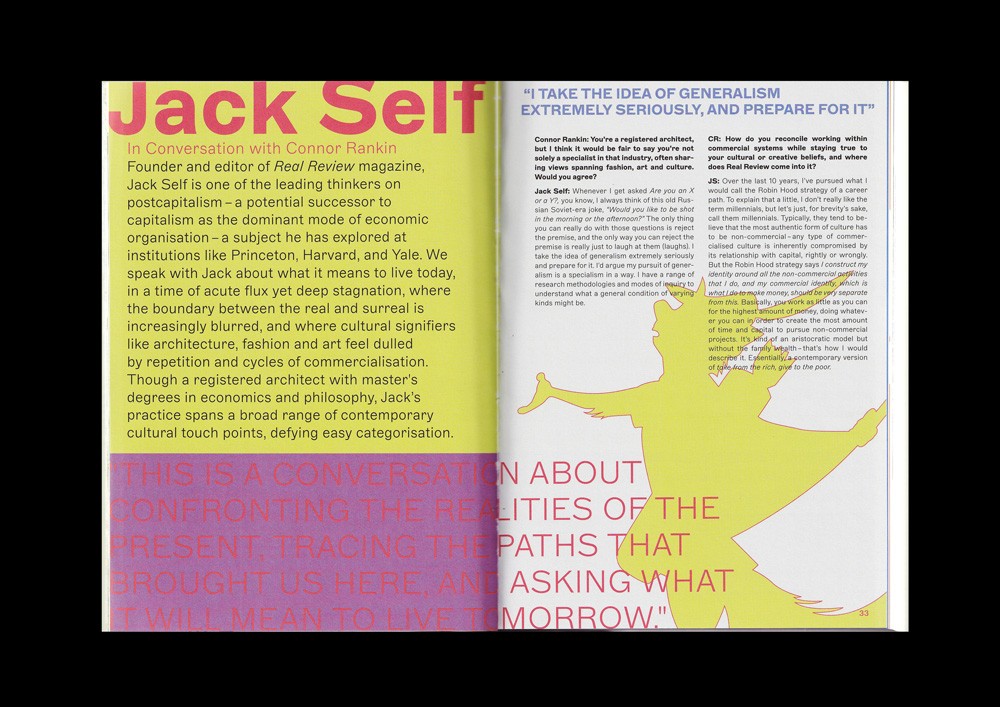
Interview: Jack Self
I speak to Jack Self about confronting the realities of the present, tracing the paths that brought us here, and asking what it will mean to live tomorrow.

Founder and editor of Real Review magazine, Jack Self is one of the leading thinkers on postcapitalism – a potential successor to capitalism as the dominant mode of economic organisation – a subject he has explored at institutions like Princeton, Harvard, and Yale. We speak with Jack about what it means to live today, in a time of acute flux yet deep stagnation, where the boundary between the real and surreal is increasingly blurred, and where cultural signifiers like architecture, fashion and art feel dulled by repetition and cycles of commercialisation. Though a registered architect with master's degrees in economics and philosophy, Jack’s practice spans a broad range of contemporary cultural touch points, defying easy categorisation
Connor Rankin: You’re a registered architect, but I think it would be fair to say you’re not solely a specialist in that industry, often sharing views spanning fashion, art and culture. Would you agree?
Jack Self: Whenever I get asked Are you an X or a Y?, you know, I always think of this old Russian Soviet-era joke, “Would you like to be shot in the morning or the afternoon?” The only thing you can really do with those questions is reject the premise, and the only way you can reject the premise is really just to laugh at them. (laughs) I take the idea of generalism extremely seriously and prepare for it. I'd argue my pursuit of generalism is a specialism in a way. I have a variety of different research methodologies and modes of inquiry in order to understand what a general condition of varying kinds might be.
CR: How do you reconcile working within commercial systems while staying true to your cultural or creative beliefs, and where does Real Review come into it?
JS: Over the last 10 years, I’ve pursued what I would call the Robin Hood strategy of a career path. To explain that a little, I don’t really like the term millennials, but let’s just, for brevity’s sake, call them millennials. They believe that the most authentic form of culture had to be non-commercial – any type of commercialised culture was inherently compromised by its relationship with capital, rightly or wrongly. But the Robin Hood strategy then said I construct my identity around all the non-commercial activities that I do, and my commercial identity, which is what I do to make money, should be very separate from this. Basically, you work as little as you can for the highest amount of money, doing whatever you can to create the most amount of time and capital to pursue non-commercial projects. It’s kind of an aristocratic model, but without the family wealth, is how I would describe it.
CR: The subject of culture only being authentic if it's non-commercial is interesting to me. I’m constantly questioning this in my own projects, and have a number of peers who believe their art forms should be entirely non-commercial. Some even believe any commercialisation will affect their creativity negatively.
JS: At Real Review, we’re working on something relevant to this, which I’d be glad to share some theory behind. The idea is still being designed, but I think it's aligned with this topic.
CR: Please do.
JS: Essentially, we have a 4-point cultural axis. At one end of the horizontal axis, we have commercial, and at the other end we have authentic—commercial being monetised cultural production and authentic being non-commercial cultural production. At one end of the vertical axis we have sincerity and at the other end we have scepticism – importantly to the theory, both are dominant emotions among millennials, but Gen Z have inherited them too.
Millennials are extremely sceptical about capitalism; they really hate it, not intellectually, like emotionally and physically, but they’re also extremely sincere. They believe that they can make a better world, and this sincerity is present from the artists all the way through to the tech bro. They all have this kind of sincere idea that the world is ready for improvement and transformation. But what that gives you is four effective typologies. You have the cynical + commercial, which I would call the smash-and-grab, which is typified by Virgil Abloh, who understood that you could not have social mobility by only getting a job and a degree. The only way you could achieve social mobility was through cultural speculation, so buying a hoodie at $50, putting a logo on it and selling it at $250 to some rich kids. You have the commercial + sincere, which is people who say, I’m going to work for an institution of some kind, and I’m going to try and change them from within, the Trojan horse. Then you have the non-commercial and cynical, which is where the Robin Hood strategy sits. These people will engage with these systems, but in a limited way, in order to achieve their own ends. So engaging with commerce, accepting the compromise of that, in order to be able to get enough money to pursue non-commercial projects. Finally you have noncommercial + sincere, which I think is some of the millennials you describe meeting. I think they are broadly comprised of actually and legitimately starving artists.
CR: Where do you and Real Review plot on this axis?
JS: Real Review is the perfect example of the non-commercial and cynical, as it's a project that isn't economically viable. In my case for working on it, I choose and accept the terms and conditions of engaging with the commercial sphere in order to create work whose value I think is not commercial, and in fact, ideally is the value which exists outside of capitalism. That’s actually what I think culture is, I think it’s human ideas and relations, and in a way kind of fantasies and hallucinations, which are outside of any dominant paradigm in society that exists at that time.
CR: Let's change the topic slightly. How does your work with Real Review relate to our theme In-Between, in relation to what it means to live today?
JS: At Real Review, we’ve been exploring modernity and working on a slightly altered definition that I haven’t really seen in academic or popular literature. I’ll simplify the journey for our conversation, but it begins around the early 15th century with the Portuguese enslaving North African pirates – the earliest revival of European slavery under Roman laws. Soon after, the Spanish combined slavery with territorial conquest, initiating colonial expansion. The Dutch then turned colonies into commercial ventures, transforming exploitation into business. The English scaled these practices globally, creating an empire spanning a quarter of the planet. From this evolved industrialisation and its technologies designed explicitly to measure and extract human and natural resources.
I think modernity would have continued as a settler colonial and imperial project with slave-based economies underneath monarchies if there had not been the American Revolution, which introduced republicanism and democracy. Capitalism emerged almost as a counter to the threat democracy posed to modernity. So, when considering this current In-Between period you talk of, modernity has been a 500-year project defined by a linear, cumulative, extractive relationship with humans and nature – one that's now coming to an end, in my opinion.
CR: How do you see the ending of this era playing out in real time?
JS: In the last 15 years, we've seen multiple social movements – Occupy, #MeToo, Black Lives Matter, Extinction Rebellion – each challenging different aspects of modernity, such as inequality, racial injustice and environmental destruction. Then the pandemic disrupted our belief in linear progress, ending the idea that each generation would inevitably be better off than the last. Finally, the events since October 7th and the genocide in Gaza have reminded Western audiences especially that colonialism remains central to modernity. Together, these events show a widespread loss of faith in modernity.
"the models which are being perpetuated, especially in the US at the moment, are inherently unstable, so I don't think it's the beginning of some terrifying techno-feudal oligarchy but rather the very end of modernity, the last gasp. I’m excited by that."
CR: As people's faith in the project fades, how do you see the tension unfolding over the next decade and how optimistic about it are you?
JS: Well, we’re now seeing the backlash to those social movements, particularly from those who have benefited most from modernity, insisting that it must continue and imposing the values of modernity, which they often call traditional values, onto societies, which in fact do not really want these types of values. It can be extremely challenging not to take a negative view of the time we are in, but the models which are being perpetuated, especially in the US at the moment, are inherently unstable, so I don't think it's the beginning of some terrifying techno-feudal oligarchy but rather the very end of modernity, the last gasp. I’m excited by that.
CR: Do we have any reference points throughout history that are similar to what we’re seeing now?
JS: Back in 2011, in Real Review, we wrote about how we might be witnessing the end of modernity, and we concluded the closest historical reference was the Renaissance, which wasn’t a pinpoint in history, it was a bridge between the medieval era and modernity. It took about 200 years for society to fully accept that feudalism was over and figure out what the new paradigm might look like. Modernity might similarly take another hundred years to end, but in a way, the engine is off. It’s rolling forward on inertia, because not enough people believe that it's a project worth continuing.
CR: This is where our – ACV’s – thinking is too. It feels like Western societies have reached a tipping point, and we’re pushing towards what's next. It's difficult to know how far into that paradigm shift we are, so I’d like to speak more about the commercialisation of culture today, and how it's holding us back. To quote you on your recent critique of Coal Drops Yard for Architectural Review, “Every countercultural or revolutionary move we make is immediately subsumed by capitalism—transformed, packaged and sold back to us.” Why do you think this is happening?
JS: Capitalism is the pursuit of profit, which means surplus, and the only way that you can achieve surplus is through extraction, because there is no surplus in nature. Capitalism is also just as happy, as we’ve seen, manufacturing bombs to execute a genocide as it is producing malls or concerts. But what often happens in the sphere of culture specifically, which is sometimes less evident in other sectors, is that the pursuit of the strategies that are required to maximise profit produce a suboptimal cultural product, which means the consumers of that product do not believe that it is the highest quality or it merits the value that has been ascribed to it. Because in the process of increasing scale and economies of scale, the quality drops – either directly or inadvertently – and then the consumer is like, this is not a quality cultural product and is upset by that. They feel exploited or robbed, right?
CR: I’d agree, and I suppose it’s just another example of people not subscribing to this project we live in anymore.
JS: Sure. Humans profoundly hate being compelled, and societies that are based on compulsion can only occur under threat of violence. And while some of those have existed for a thousand years, I ultimately think that if you give someone the option or opportunity to resist that kind of compulsion, they will take it. So if we imagine that you must have this right to refuse this compulsion, then when presented with commercialised culture that's being packaged and sold back to us, we suspect that the person who has produced the cultural product had no ability to refuse.
CR: In Real Review 15, you wrote an article called “The End of Ideas”, where you critique the creativity landscape of culturally adjacent industries such as art and fashion, blaming commercial pressures. You land your point that these pressures discourage radical newness. Do you think these same commercial pressures nullify our ability to imagine and build a more just society?
JS: I think you can make that comparison, yes, because this process of commercial de-risking is essential to late-stage capitalism and is a product of the rise of our ability to measure commerce in general. Before 2000, your ability to get metrics on any commercial project was quite limited. You didn’t really know what people thought about many things. Now that we have a whole host of tools that are able to gain metrics, and the granularity of those metrics is so precise that it gives designers the ability to massively de-risk their products. The long-term effect of that is highly problematic because it destroys the possibility of the very innovation and transformation that we need for evolving and emerging cultures of making a proposal or being contemporary.
CR: How can we break free from that trend?
JS: If you’re an individual, it means doing something without really fully thinking through the consequences, in my view. I’m not encouraging people to behave recklessly, but I am encouraging people to do things without knowing exactly what it will lead to. Take Real Review, for example. I was told nobody would want to buy this magazine. They want to buy magazines about boats, guns, dogs and bikinis. They don’t want to buy a magazine about the contemporary – like, what even is that? Yet it created an audience with whom it resonated. It’s important to take risks – the worst that can happen most of the time is that you lose your money and your time. I think people generally have a risk aversion. So they tend to catastrophise the risk of something failing, like what if nobody supports my Kickstarter, or what if no one subscribes to my Patreon or OnlyFans, et cetera. So I think taking risks without a huge expectation of what the outcome is going to be is a really important form of resistance to what I’ve described. In fact, it’s what we need in the cultural sphere to shift the existing paradigm.
"The best I can hope for is to be a data point among a whole host of other data points, which indicate that the shoal of fish which constitutes our humanity is debating a turn."
CR: Finally Jack, in the midst of the In-Between, how do you live your life in alignment with the kind of society you want to see?
JS: It would be naive to think that the legacy of the forces I’ve described could be overturned by one person or that any individual truly has the power to reject society. You’re only really presented with two strategies: One is you can try to create your own “walled garden” or “private island” as a means of resistance – you limit your experience of the world and draw a boundary and say anything that occurs outside of this, I cannot engage with. The other is to acknowledge the complexities and nuances of the world and to struggle against the world in the knowledge that you will absolutely fail. You cannot succeed. It is not possible for me as an individual or with the means and resources that I have at my disposal to profoundly change society. The best I can hope for is to be a data point among a whole host of other data points, which indicate that the shoal of fish which constitutes our humanity is debating a turn.
In that sense, I try to live my values every day. I constantly question what I can do for other people, how I can live better in service of others, and I am using the talents and resources that I have to their best effects to support those values.
But, it’s a challenge.